What is Stem Cell Therapy?
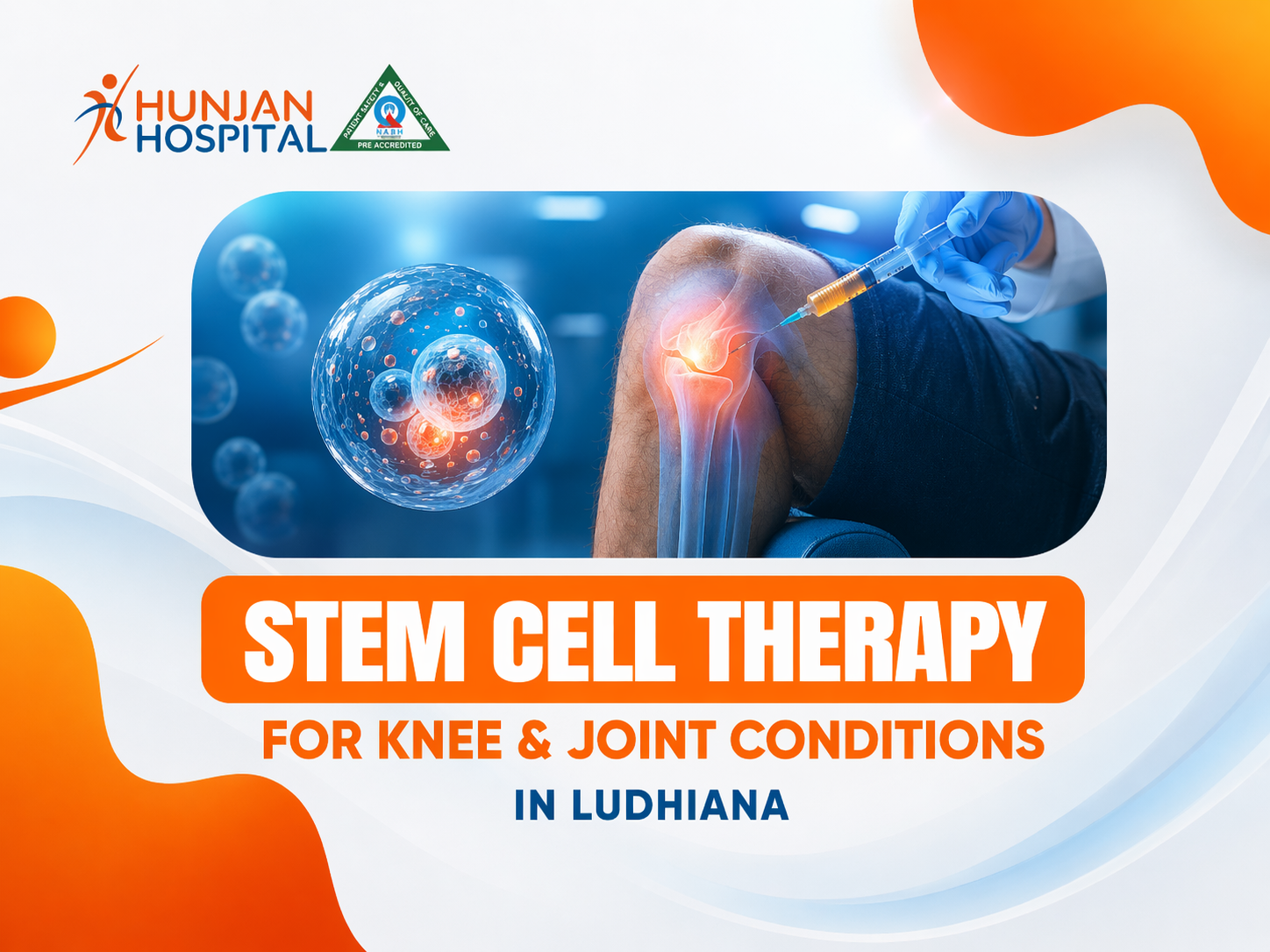
Stem cell therapy is a regenerative orthopedic treatment that may be considered in selected patients to support healing in joints and soft tissues where natural recovery is limited. In orthopedic practice, the goal is not to create a completely new joint, but to help improve the joint environment, reduce inflammation, support function, and preserve the joint for as long as possible.
At Hunjan Hospital Ludhiana, stem cell therapy in orthopedics may be discussed as part of a personalized treatment plan for carefully selected patients with early joint degeneration, cartilage injury, or certain tendon and ligament conditions. It should be understood as a supportive and evolving treatment option, not a guaranteed cure.
Where is it used?
This treatment is generally considered in selected orthopedic conditions where damage has started but is not yet advanced.
- Early-stage knee arthritis
- Cartilage injuries due to degeneration or trauma
- Certain cases of shoulder pain related to overuse or age-related changes
- Ligament or tendon injuries that are not healing adequately
- Sports injuries requiring biological support for recovery
For patients searching for stem cell therapy for knee pain in Ludhiana, non-surgical orthopedic treatment in Ludhiana, or joint preservation treatment at Hunjan Hospital Ludhiana, it is important to know that suitability depends on the stage of the condition, clinical findings, and imaging evaluation.
How does it work?
The procedure involves using the patient’s own biological material to support the healing response at the affected site.
- Cells may be obtained from sources such as bone marrow or fat tissue under sterile conditions
- The collected material is processed to concentrate the required biological components
- The prepared material is then placed into the affected joint or tissue with precision
- The aim is to support the local healing environment and reduce inflammation
- Over time, some patients may experience improvement in function and symptoms
Current orthopedic understanding suggests that any benefit is more likely related to changes in the biological environment of the joint rather than guaranteed regrowth of normal cartilage. Response is usually gradual and depends on the condition being treated.
What are the benefits?
In selected cases, stem cell therapy may offer functional improvement without immediate major surgery.
- Minimally invasive compared with major joint surgery
- Uses the patient’s own cells or biological material in many protocols
- May help reduce pain in some patients
- May support joint function and mobility
- May be considered as a joint preservation approach in early stages of degeneration
- May help delay more invasive procedures in carefully selected cases
However, results are not immediate or guaranteed, and improvement can vary from patient to patient. Current evidence does not support presenting stem cell therapy as a proven replacement for standard treatment in advanced arthritis.
Who can consider this treatment?
Stem cell therapy is typically considered for patients in the early to moderate stages of joint degeneration, where there is still enough joint structure to support recovery. It may be suitable for individuals who continue to have pain, stiffness, or activity-related discomfort despite medication, lifestyle modification, or physiotherapy and who are exploring treatment before surgery.
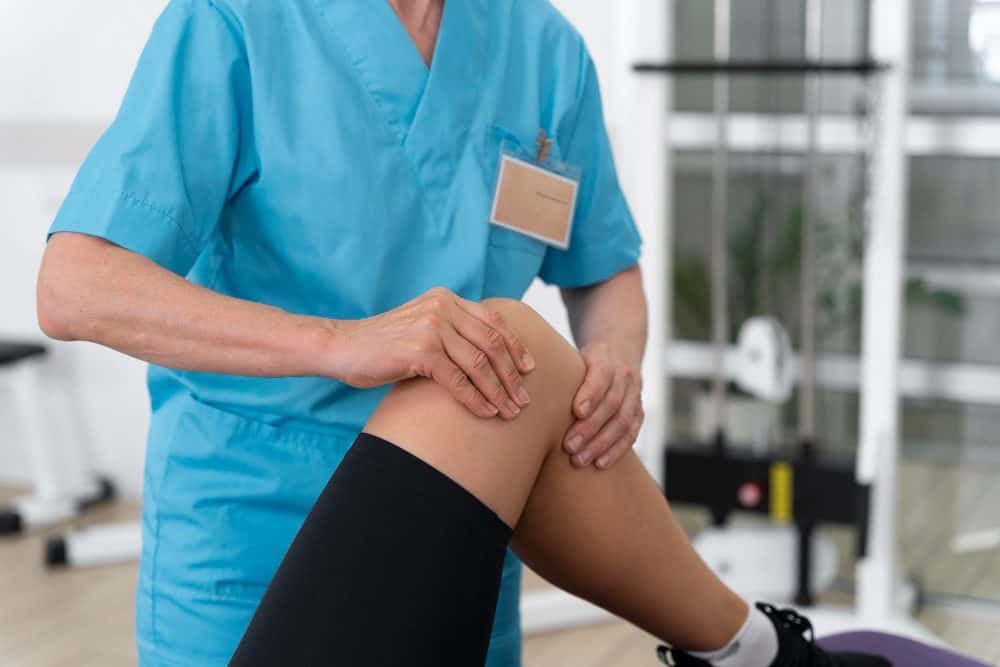
At Hunjan Hospital Ludhiana, a detailed orthopedic assessment is important before recommending this treatment. This usually includes symptom review, physical examination, imaging, previous treatment history, and discussion of realistic expectations.
In cases of advanced arthritis, severe joint damage, or major deformity, the role of stem cell therapy is limited, and other established orthopedic treatments may be more appropriate.
What people often misunderstand
- It does not regenerate an entirely new joint
- It does not reliably reverse severe arthritis
- It is not a permanent alternative to surgery in advanced conditions
- Relief is usually gradual, not immediate
- Outcomes vary based on joint condition, severity, age, activity level, and other medical factors
This is one of the most important points for any patient looking for stem cell therapy in Ludhiana or advanced orthopedic care at Hunjan Hospital Ludhiana. Proper diagnosis and realistic expectations matter as much as the procedure itself.
What to expect after the procedure
- Mild soreness or discomfort may be present for a short period
- Improvement is usually gradual over weeks to months
- Activity modification may be advised in the early recovery period
- Physiotherapy or guided rehabilitation may be recommended
- Follow-up is important to monitor progress and response
As with any medical procedure, expected recovery and outcome depend on the joint involved, the severity of the condition, and the overall treatment plan.
Final thought
Stem cell therapy in orthopedics is not about choosing a newer treatment just because it is advanced. It is about choosing the right treatment at the right stage for the right patient.
At Hunjan Hospital Ludhiana, the focus should always remain on proper patient selection, clear diagnosis, realistic expectations, and evidence-based orthopedic care. In selected cases, stem cell therapy may support joint function and improve quality of life, but it should be discussed as part of a balanced treatment plan, not as a guaranteed solution.
Medical Disclaimer: The information in this article is for educational purposes only and does not replace professional medical advice, diagnosis, or treatment. Always consult a qualified doctor for medical concerns or treatment decisions. Outcomes may vary from patient to patient.