Cashless Treatment at Hunjan Hospital, Ludhiana
Your Complete Guide to Cashless Hospitalization, Insurance Claims & TPA Support
Hunjan Super Speciality Hospital | Ludhiana, Punjab | NABH Pre-Accredited
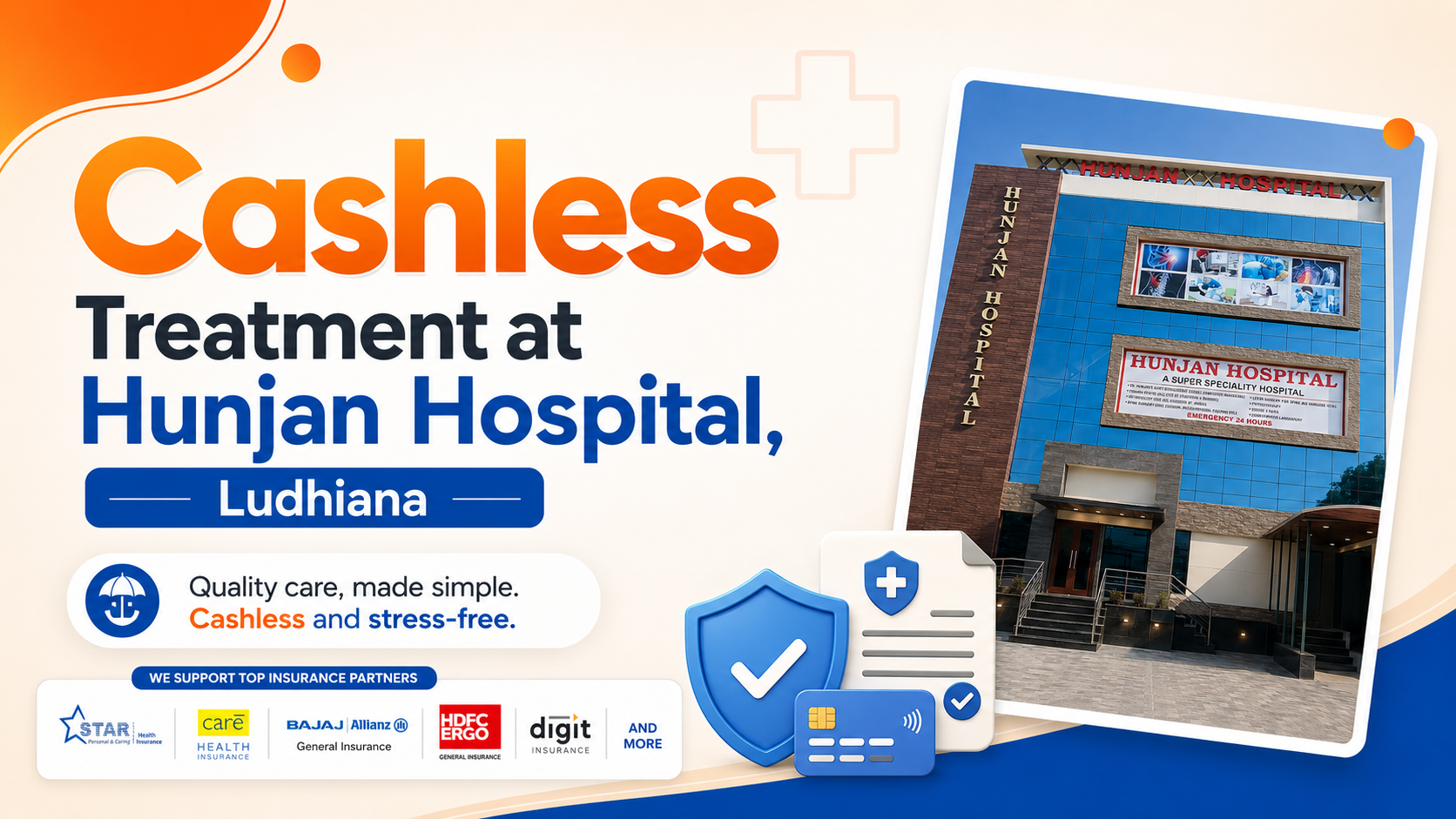
When a family member needs surgery or hospitalisation, the last thing you want to worry about is arranging funds. Hunjan Super Speciality Hospital in Ludhiana offers a fully supported cashless facility that lets you focus entirely on recovery — not paperwork. Empanelled with over 100 insurance brands, the hospital’s dedicated insurance desk handles pre-authorisation, claim coordination, and discharge documentation so your family experiences a smooth, stress-free process from admission to discharge.
What Is a Cashless Facility in a Hospital?
A cashless facility — also called cashless hospitalisation or cashless treatment — is a benefit offered by health insurance policies through empanelled hospitals. Under this arrangement, the hospital settles medical bills directly with your insurance company or Third-Party Administrator (TPA). You are not required to pay the covered treatment costs out of pocket at the time of admission or discharge.
For patients undergoing planned procedures such as robotic knee replacement, joint replacement surgery, spine surgery, or general surgery in Ludhiana, the cashless route removes the burden of arranging large sums before treatment begins.
Why Choose Hunjan Hospital for Cashless Treatment in Ludhiana?
Hunjan Super Speciality Hospital is one of North India’s most trusted orthopaedic hospitals, led by Dr. Balwant Singh Hunjan — a pioneer with over 40 years of experience who performed the first true robotic knee replacement in North India. Here is why it stands out as a preferred cashless hospital in Punjab:
- 100+ Empanelled Insurance Brands: From major public sector insurers like National Insurance Company and SBI General to private giants like Star Health, ICICI Lombard, HDFC ERGO, Bajaj Allianz, and Tata AIG — the hospital is recognised by a wide network of insurers and TPAs.
- NABH Pre-Accreditation: As a NABH Pre-Accredited hospital, Hunjan Hospital meets national quality and patient-safety standards. Most insurance companies give preferred status to NABH-accredited facilities, which can speed up cashless approvals.
- Dedicated Insurance Desk: A trained team assists patients with pre-authorisation requests, estimate letters, claim coordination, and discharge documentation — reducing delays and confusion at every step.
- Specialist Orthopaedic Focus: For high-cost procedures like robotic knee replacement (costing several lakhs), having a cashless facility directly at the hospital that performs the surgery is a significant financial relief for families.
- 40+ Years of Trusted Care: With 8,000+ knee replacements and 15,000+ hip replacements performed, the hospital has an established track record that insurers trust — which supports smoother claim approvals.
Insurance Companies & TPAs Empanelled with Hunjan Hospital
Hunjan Hospital is authorised by over 100 insurance brands. The following are among the confirmed insurance partners and TPAs:
- Star Health and Allied Insurance
- HDFC ERGO Health Insurance
- ICICI Lombard General Insurance
- Bajaj Allianz General Insurance
- Tata AIG General Insurance
- Aditya Birla Health Insurance
- SBI General Insurance
- National Insurance Company
- Religare Health Insurance (Care Health)
- IFFCO Tokio General Insurance
- Zurich Kotak General Insurance
- Universal Sompo General Insurance
- Cigna Healthcare
- Medi Assist TPA
- FHPL (Family Health Plan Insurance TPA)
- Vidal Health TPA
Note: This list is not exhaustive. Contact the hospital directly to confirm whether your specific policy, insurer, or TPA is eligible for cashless treatment.
Ayushman Bharat Card (PM-JAY) at Hunjan Hospital
Hunjan Hospital is empanelled under the Ayushman Bharat Pradhan Mantri Jan Arogya Yojana (PM-JAY) — India’s largest government-funded health insurance scheme. If you or a family member holds an Ayushman Bharat card (also known as a Golden Card or ABHA card), you can avail cashless treatment at Hunjan Hospital with no out-of-pocket expense up to the scheme’s coverage limit.
Key Benefits of PM-JAY at Hunjan Hospital
- Health coverage up to ₹5 lakh per family per year: Under PM-JAY, eligible families receive cashless health coverage of up to ₹5 lakh annually, covering hospitalisation, surgery, and treatment costs.
- 177+ surgeries covered: A wide range of orthopaedic surgeries, general surgeries, gynaecological procedures, and more are covered under the scheme at Hunjan Hospital.
- No premium required: PM-JAY is fully funded by the government. Beneficiary families do not pay any premium or registration fee.
- Completely cashless: Eligible patients pay nothing at the hospital for covered treatments — the government settles the costs directly with the hospital.
How to Use Your Ayushman Card at Hunjan Hospital
- Carry your Ayushman Bharat card (physical or e-card on the PM-JAY app) along with a valid government ID.
- Inform the hospital’s admission desk that you wish to avail treatment under PM-JAY.
- The hospital will verify your eligibility and the treatment category on the PM-JAY portal.
- Once approved, your treatment proceeds on a fully cashless basis up to the coverage limit.
- For any queries before visiting, call 8556024365 to confirm PM-JAY eligibility for your specific treatment.
Note: PM-JAY coverage is subject to the treatment being listed under the scheme’s package rates and the patient’s eligibility as a registered beneficiary. Not all procedures may be covered. Please verify with the hospital before admission.
How to Avail Cashless Facility at Hunjan Hospital: Step-by-Step
Following these steps will help ensure a smooth cashless admission:
- Step 1 — Verify Eligibility Before Admission
Call the hospital’s insurance desk at 8556024365 before your admission date. Confirm that your policy, TPA, and treatment category are eligible for cashless approval. This prevents last-minute surprises.
- Step 2 — Carry the Required Documents
Bring all necessary documents on the day of admission (see checklist below). Incomplete documents are the most common reason for cashless claim delays.
- Step 3 — Submit Pre-Authorisation Request
The hospital’s insurance desk submits a pre-authorisation request to your insurer or TPA on your behalf. This includes a treatment estimate, diagnosis details, and doctor’s notes.
- Step 4 — Await Approval
Most insurers respond within a few hours for planned admissions. Your insurer may approve the full amount, a partial amount, or ask for additional information. The hospital team will keep you informed.
- Step 5 — Receive Treatment
Once pre-authorisation is granted, your treatment proceeds. Any amount not covered by the insurer (co-pay, non-covered items, or amounts above the sum insured) will need to be settled by you.
- Step 6 — Discharge & Final Settlement
At discharge, the hospital submits the final claim documents directly to the insurer. The insurer settles the approved amount with the hospital. You receive a clear summary of what was covered and what, if any, balance is due.
Documents Required for Cashless Hospitalisation
Carry the following documents to avoid delays in cashless claim processing:
- Health insurance card (original or digital copy)
- Government-issued photo ID (Aadhaar, PAN, Passport, or Voter ID)
- Insurance policy document or policy number
- TPA card (if your policy is managed by a TPA)
- Doctor’s referral letter or prescription recommending hospitalisation
- Previous diagnostic reports, X-rays, MRIs, or test results related to the condition
- Pre-authorisation approval letter from insurer (if already obtained)
- Any TPA forms shared by your insurance company before admission
Treatments Covered Under Cashless Facility at Hunjan Hospital
Subject to your policy’s terms and sum insured, cashless treatment may be available for the following procedures and services offered at Hunjan Hospital:
- Robotic Knee Replacement Surgery: The hospital’s flagship procedure — one of the most precise knee replacement techniques available in North India, using robotic-assisted technology.
- Orthopaedic & Joint Replacement Surgery: Hip replacement, shoulder replacement, and other complex joint procedures for arthritis, fractures, and degenerative conditions.
- Spine Surgery: Treatment for disc herniation, spinal stenosis, spondylosis, and other spinal conditions.
- General Surgery: A range of surgical procedures including hernia repair, appendicectomy, and other abdominal surgeries using minimally invasive approaches.
- Trauma & Emergency Surgery: Management of fractures, dislocations, and acute orthopaedic injuries.
- Physiotherapy & Rehabilitation: Post-surgical rehabilitation programmes for joint replacement, spine, and trauma patients.
- Gynaecology: Gynaecological procedures as applicable under your policy.
Important: Coverage depends entirely on your individual policy terms. Always verify with your insurer or TPA before admission. The hospital can assist with this verification.
Frequently Asked Questions: Cashless Facility at Hunjan Hospital
Question: Is Ayushman Bharat card valid at Hunjan Hospital, Ludhiana?
Answer: Yes. Hunjan Hospital is empanelled under the Ayushman Bharat PM-JAY scheme. Eligible beneficiaries can avail cashless treatment for covered procedures with no out-of-pocket cost, up to ₹5 lakh per family per year. Carry your Ayushman card and a valid government ID, and inform the admission desk at the time of arrival.
Question: Is Hunjan Hospital empanelled with my health insurance company?
Answer: Hunjan Hospital is empanelled with over 100 insurance brands including Star Health, ICICI Lombard, HDFC ERGO, Bajaj Allianz, Tata AIG, SBI General, National Insurance, and many TPAs. Call 8556024365 to verify whether your specific insurer is on the approved panel.
Question: Can I get cashless treatment for robotic knee replacement at Hunjan Hospital?
Answer: Yes, robotic knee replacement is a planned surgical procedure that is typically eligible for cashless hospitalisation, subject to your policy terms, sum insured, and insurer approval. The hospital’s insurance desk will help you initiate the pre-authorisation process.
Question: How long does cashless pre-authorisation take?
Answer: For planned admissions, most insurers respond within 2 to 6 hours of receiving a complete pre-authorisation request. Emergency cases are typically processed faster. The hospital’s insurance team submits the request on your behalf.
Question: Will I have to pay anything under the cashless facility?
Answer: You may need to pay any applicable co-pay amount specified in your policy, charges for items excluded under your policy, or any amount that exceeds your sum insured. The hospital provides a clear breakdown at discharge.
Question: What if my insurer only partially approves the cashless claim?
Answer: If the insurer approves only a portion of the treatment cost, you will need to settle the remaining balance at discharge. The hospital team will inform you of any shortfall before or during treatment so you can plan accordingly.
Question: Can I still get treatment at Hunjan Hospital if my insurer is not on the cashless panel?
Answer: Yes. If your insurer is not empanelled for cashless treatment, you can pay the treatment costs and later submit a reimbursement claim to your insurance company. The hospital will provide all necessary bills, reports, and discharge documentation to support your claim.
Question: What is a TPA and how does it affect cashless claims?
Answer: A Third-Party Administrator (TPA) is an intermediary company authorised by your insurer to process and manage health insurance claims. Many policies are managed by TPAs such as Medi Assist, FHPL, or Vidal Health. If your policy has a TPA, carry your TPA card and contact them for pre-authorisation alongside the hospital insurance desk.
Tips to Ensure a Smooth Cashless Claim
- Call the hospital insurance desk at least 24–48 hours before a planned admission.
- Inform your TPA or insurer about the planned hospitalisation in advance, as some policies require prior intimation.
- Carry original documents — photocopies may not be accepted by all TPAs.
- Check your policy for any waiting periods, sub-limits on specific procedures, or co-pay clauses before admission.
- Keep a digital backup of all insurance documents on your phone for quick access.
- If your policy covers a family member, ensure you carry their insurance card and ID along with the patient’s ID.
About Hunjan Super Speciality Hospital
Hunjan Super Speciality Hospital is a NABH Pre-Accredited orthopaedic and multi-speciality hospital located in Ludhiana, Punjab. Founded and led by Dr. Balwant Singh Hunjan (MBBS, MS Orthopaedics, M.Ch Orthopaedics), the hospital has over 40 years of experience in orthopaedic care and is recognised as a centre of excellence for joint replacement surgery in North India.
- 8,000+ knee replacements performed
- 15,000+ hip replacements performed
- First true robotic knee replacement hospital in North India
- 100+ specialist team members
- 24×7 emergency and trauma care
- 10+ national awards for healthcare excellence
Contact Hunjan Hospital for Cashless Treatment
To confirm your insurance eligibility, understand the pre-authorisation process, or book an appointment:
- Phone: 8556024365
- Email: info@hunjanhospital.com
- Website: www.hunjanhospital.com/insurance
- Address: 111, Kochar Market Rd, Sampooran Colony, South Model Gram, Ludhiana, Punjab 141002
- OPD Hours: Monday to Saturday, 8:00 am – 8:00 pm
- Emergency: 24×7
Disclaimer: The information in this article — including insurance empanelments, claim procedures, and document requirements — is subject to change. Please call us at 8556024365 or email info@hunjanhospital.com before admission to confirm your current insurance eligibility and requirements.